 34% OFF
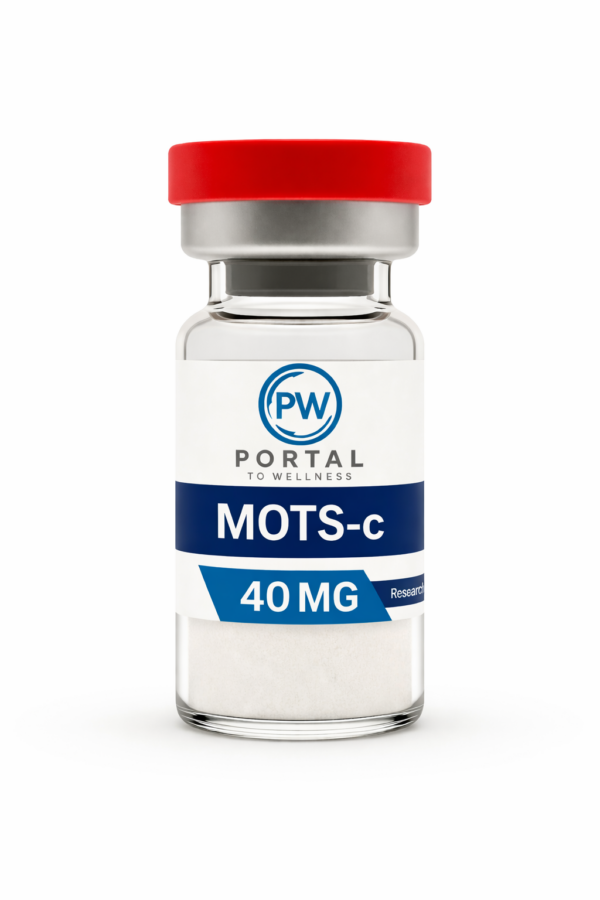
MOTS-c – 40mg/vial (Research Use Only)
A mitochondrial-derived peptide encoded in the 12S rRNA region, studied for its interaction with AMPK signalling and metabolic regulation in published research. Supplied for laboratory research and identification purposes only. Independent lab result for batch PTW-MOTSC40-2608-001: 98.940% purity, 44.65 mg per vial (Janoshik Analytical, task #243315).
Availability: In stock
3–4 vials — 5% off · 5–9 vials — 10% off · 10+ vials — 15% off
Applied automatically in the cart. Combines with a discount code up to 20% off in total, and stacks on top of the subscription discount.
Research Disclaimer: All products currently listed on this site are for research purposes only.
- Encoded in mitochondrial DNA rather than the nuclear genome
- Studied for AMPK activation and mitochondrial metabolic signalling
- Studied for insulin sensitivity and glucose uptake in skeletal muscle models
- Described in the literature as exercise-mimetic in its metabolic signalling; no hormonal axis involvement documented
- Circulating MOTS-c levels are reported to decline with age and to rise acutely with exercise
Research FAQ
What is MOTS-c studied for?
MOTS-c is studied as a metabolic regulator that activates AMPK and improves insulin sensitivity, with effects that mirror aerobic-exercise adaptations. Sold for research use only.
How does MOTS-c differ from Humanin?
MOTS-c is a metabolic mitochondrial peptide acting via AMPK, while Humanin is a cytoprotective mitochondrial peptide acting via GP130/STAT3. Both are encoded in mitochondrial DNA.
Mechanism of Action
MOTS-c is a mitochondria-derived peptide (MDP) encoded within the 12S rRNA gene of mitochondrial DNA, originating outside the nuclear genome. Under metabolic stress it translocates to the nucleus, activating AMPK and the FOXO signalling pathway. Published work reports effects on mitochondrial efficiency, glucose uptake in skeletal muscle, and systemic metabolic signalling that parallels aerobic exercise at the molecular level.
Research Overview
Lee et al. (2015, Cell Metabolism) demonstrated that MOTS-C improved insulin sensitivity, prevented high-fat diet-induced obesity, and extended metabolic healthspan in mouse models. Subsequent studies confirmed that circulating MOTS-C levels decline significantly with age in humans and rise acutely with exercise — positioning it as a molecular mediator of exercise's systemic metabolic benefits. Human research is active, with trials exploring applications in metabolic disease and age-related functional decline.
Research & Stack Notes
MOTS-c and NAD+ precursors such as NMN act on mitochondrial function through different pathways. SS-31 addresses membrane structure where MOTS-c addresses AMPK-mediated metabolic signalling. No adverse interactions with other research compounds are documented.
Educational purposes only. Research use. Not evaluated by the FDA.
Independent lab result · batch PTW-MOTSC40-2608-001
MOTS-c 40mg. Tested by Janoshik Analytical (task #243315), analysis conducted 23 Oct 2026. The sample was pulled from our own stock, submitted and paid for by Portal to Wellness, and the report names us as the client.
- Identity: MOTS-c, confirmed by MOTS-c analysis
- Measured content: 44.65 mg per vial (labelled 40 mg)
- Purity: 98.940% (HPLC)
View and verify the full report on Janoshik’s site →
This result applies to batch PTW-MOTSC40-2608-001. The batch number is printed on the vial label. See all published results on our Lab Testing & Verification page.
Overview
MOTS-c (Mitochondrial Open Reading Frame of the 12S rRNA-c) is a 16-amino acid mitochondria-derived peptide (MDP) encoded within the 12S rRNA gene of the mitochondrial genome. Since its discovery at USC, MOTS-c has generated significant research interest as a metabolic regulator with exercise-mimetic properties in preclinical models. Published research has examined its role in AMPK pathway activation, folate cycle modulation, and systemic metabolic programming, positioning it alongside humanin as a founding member of the mitochondrial peptide research field.
What It Is
MOTS-c is a 16-amino acid peptide with the sequence MRWQEMGYIFYPRKLR and MW approximately 2,174 Da, encoded within the 12S rRNA gene of human mitochondrial DNA. CAS number: 1627580-64-6. MOTS-c translocates to the nucleus under metabolic stress conditions and regulates AMPK activation, folate/methionine cycle modulation, and antioxidant response elements.
Key Research Applications
- Mitochondria-derived peptide (MDP) biology and mtDNA-encoded signaling research
- AMPK activation, metabolic sensing, and cellular energy homeostasis studies
- Folate cycle and one-carbon metabolism regulation research
- Exercise-mimetic pharmacology and skeletal muscle metabolic programming studies
- Insulin sensitivity, glucose utilization, and metabolic flexibility research
- Nuclear translocation and mitochondrial-nuclear communication studies
- Age-associated metabolic parameter research — MOTS-c plasma level dynamics in aged animal models
- Comparative MDP research alongside Humanin and other mitochondrial peptides
Technical Specifications
| Amino Acids | 16 (MRWQEMGYIFYPRKLR) |
| Molecular Weight | ~2,174 Da |
| CAS Number | 1627580-64-6 |
| Origin | Mitochondrial 12S rRNA gene-encoded peptide (mtDNA) |
| Mechanism | AMPK Activator; Folate Cycle Regulator; Metabolic Reprogrammer |
| Purity | ≥98% (supplier specification) |
| Form | Lyophilized powder |
| Vial Size | 40mg |
For laboratory research use only. Not intended for human or veterinary use, medical diagnosis, treatment, or prevention of any disease or condition. This product has not been evaluated by the FDA or any regulatory agency. Must be handled by qualified research personnel in a compliant laboratory setting.
Not sure which compounds fit your research? Browse the Research Hub →
Related research (educational)
- Overlapping Pathways in Circadian, Repair and Mitochondrial Biology
- MOTS-c: The Mitochondrial-Derived Peptide Explained
- Why Researchers Study NAD+: Energy, Longevity & the Hallmarks of Aging
Regulatory Status Note
On July 23–24, 2026, FDA’s Pharmacy Compounding Advisory Committee reviewed whether BPC-157, TB-500, KPV, MOTS-c, Semax, Epitalon, and emideltide (DSIP) should be added to the 503A Bulks List for pharmacy compounding. The committee voted to recommend six of the seven; emideltide (DSIP) was not recommended. FDA’s own briefing documents had recommended against all seven.
A committee vote is a recommendation only. It does not constitute FDA approval, does not establish safety or effectiveness, and does not change the status of this product, which is sold strictly for research use. FDA must complete formal rulemaking before any substance is added to the list. Source: FDA Advisory Committee Calendar. Last reviewed: August 17, 2026.
Update (July 22, 2026): FDA has posted its scientific briefing documents for the July 23–24 committee meeting. FDA staff are recommending against adding MOTS-c to the 503A Bulks List, alongside six other reviewed peptides, citing gaps in characterization, effectiveness, and human safety data — consistent with the human-exposure-data gap already noted above.
At a Glance: Four Separate Questions
- Research status: Sold for research/laboratory use only, not as a consumer drug.
- Compounding status: An FDA advisory committee recommended possible inclusion on the 503A Bulks List (non-binding). FDA has not issued a final decision.
- FDA approval status: Not FDA-approved for any use.
- Evidence status: Early-stage research on mitochondrial function and energy metabolism; FDA has stated no human exposure data has been identified for any route of administration.
Last reviewed: August 9, 2026 — status unchanged (still an advisory committee recommendation; not final 503A inclusion or FDA approval). See our full explainer on these four categories.
Research Library
- BPC-157, TB-500 and MOTS-c: Inside the FDA’s July 2026 Compounding Review
- FDA PCAC July 2026: BPC-157, TB-500, and MOTS-c Under Official Review
- BPC-157, TB-500, and MOTS-c Under FDA Advisory Review: What Researchers Need to Know
- FDA’s July 2026 503A Review: What It Means for BPC-157, TB-500, and MOTS-c Researchers
- What the July 2026 FDA Compounding Advisory Committee Means for Peptide Researchers
Update — July 24, 2026: On July 23, the committee voted. BPC-157, KPV, and TB-500 each passed 8-6 with one abstention; MOTS-c passed 7-5 with two abstentions. The recommendation is non-binding — FDA is not required to follow it, must still issue a formal decision, and the process may require additional rulemaking before any compounding pharmacy could act on it. No peptide has been FDA-approved, and this update does not constitute or imply a therapeutic claim. Source: STAT News
- Processing: Orders ship within 1–2 business days
- Domestic delivery: 3–5 business days via USPS Priority / UPS Ground
- Free shipping on orders over $100
- Temperature handling: Cold-chain packaging available on request for lyophilized peptides
- Tracking: Emailed automatically at time of dispatch
- Store lyophilized (dry) peptides at −4 °F for long-term stability
- Protect from light and moisture at all times
- Do not freeze
- Where the Storage row in the product specification above differs, follow the specification
Pairs Well With
Related research products
Reviews
There are no reviews yet.